
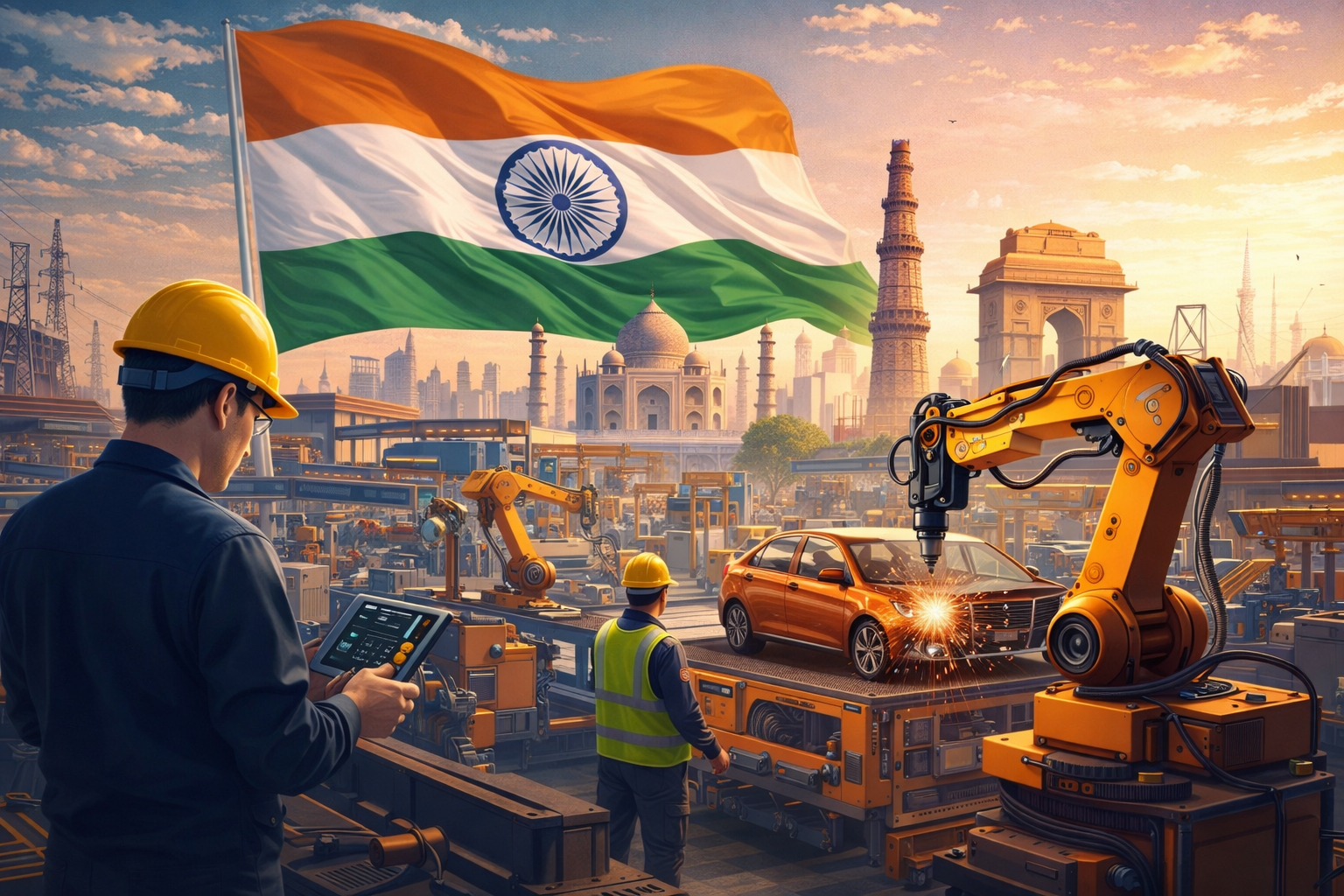
Manufacturing in India in 2026 stands at a crucial turning point as government-led reforms, PLI schemes, and global supply chain shifts reshape the sector.
As India moves closer to 2026, manufacturing has once again become a central pillar of the country’s economic strategy. From policy announcements to ground-level execution, the focus on building India as a global manufacturing hub is stronger than ever. But while opportunities are expanding rapidly, challenges still remain. The real question is whether India can convert intent into long-term impact.
From an Indian perspective, the answer leans toward opportunity, provided momentum continues.
Manufacturing in India in 2026: Current Scenario
Over the past few years, the Indian government has taken consistent steps to strengthen manufacturing. Initiatives such as Make in India, Production Linked Incentive (PLI) schemes, and massive infrastructure spending are not short-term measures but part of a long-term vision.
Key focus areas include:
- Improving ease of doing business
- Encouraging domestic and foreign manufacturing investments
- Strengthening supply chains
- Reducing import dependence in critical sectors
By 2026, these policies are expected to show deeper results, especially in sectors like electronics, defence manufacturing, renewable energy equipment, automobiles, and pharmaceuticals.
Why Manufacturing Is a Big Opportunity for India
1. Rising Global Demand for Supply Chain Diversification
With global companies actively looking to reduce over-dependence on single-country manufacturing hubs, India is emerging as a natural alternative. Stable governance, a large domestic market, and improving logistics give India a strategic advantage.
2. Strong Domestic Consumption
India’s growing middle class creates steady internal demand. Unlike export-only economies, Indian manufacturers benefit from both domestic and global markets, reducing risk during global slowdowns.
3. Infrastructure Expansion
Investments in highways, ports, railways, industrial corridors, and logistics parks are lowering transportation costs and improving efficiency. These improvements directly support manufacturing competitiveness.
4. Skilled and Young Workforce
With one of the world’s youngest workforces, India has a demographic advantage. Government-backed skill development programs are aligning workers with industry needs, especially in manufacturing and industrial technology.
The Challenges That Still Need Attention
While the opportunity is significant, manufacturing growth is not without hurdles.
1. Cost Competitiveness
India still faces challenges related to power costs, logistics efficiency in certain regions, and compliance complexity for small manufacturers.
2. MSME Integration
Micro, Small, and Medium Enterprises form the backbone of Indian manufacturing, but access to finance, technology, and global markets remains uneven.
3. Technology Adoption
Advanced manufacturing requires automation, AI-driven systems, and precision engineering. Adoption is improving, but the pace must increase to match global standards.
4. Global Economic Uncertainty
Geopolitical tensions, fluctuating commodity prices, and changing trade policies can temporarily impact manufacturing momentum.
Government Policy as a Stabilising Force
One of India’s strengths going into 2026 is policy continuity. Unlike sudden shifts, the government has maintained a consistent manufacturing roadmap, providing confidence to investors and businesses.
Focused reforms in taxation, digital compliance, and industrial policy signal long-term commitment rather than short-term experimentation. This stability plays a critical role in converting challenges into manageable risks.
What 2026 Could Look Like for Indian Manufacturing
If current trends continue, 2026 could mark a turning point where:
- India becomes a key manufacturing base for electronics, EVs, and green energy components
- Export-oriented manufacturing gains momentum alongside domestic demand
- Job creation accelerates across industrial clusters
- MSMEs integrate deeper into global supply chains
The shift may not be instant, but it will be structural and long-lasting.
Conclusion
Manufacturing in India by 2026 is less a challenge and more an opportunity under construction. While obstacles remain, the direction is clear and deliberate. Strong government backing, infrastructure development, demographic strength, and global realignment all work in India’s favour.
For businesses, investors, and workers willing to adapt and innovate, India’s manufacturing journey presents not just growth, but transformation. The coming years may well define India’s position in the global manufacturing order for decades to come.